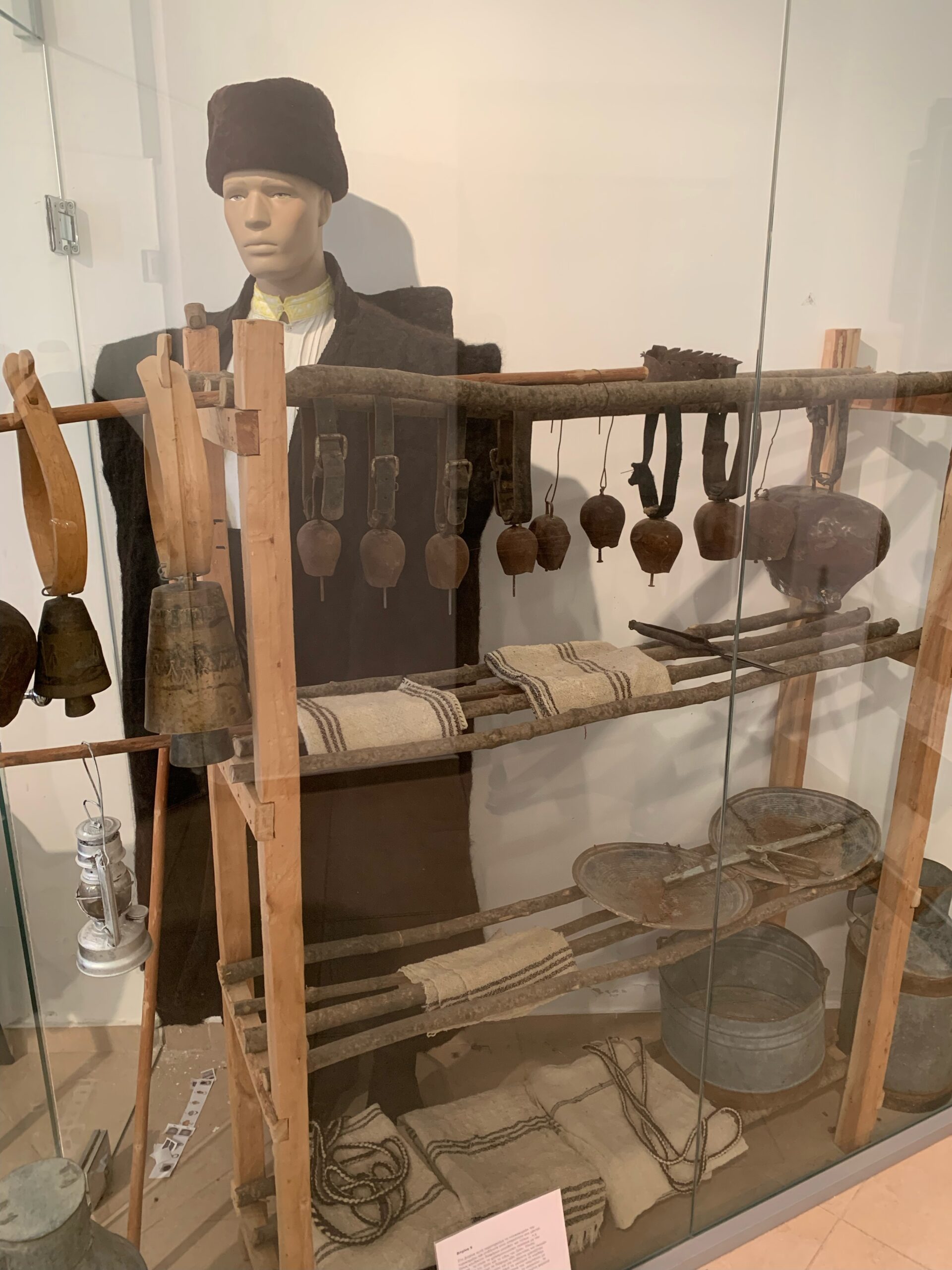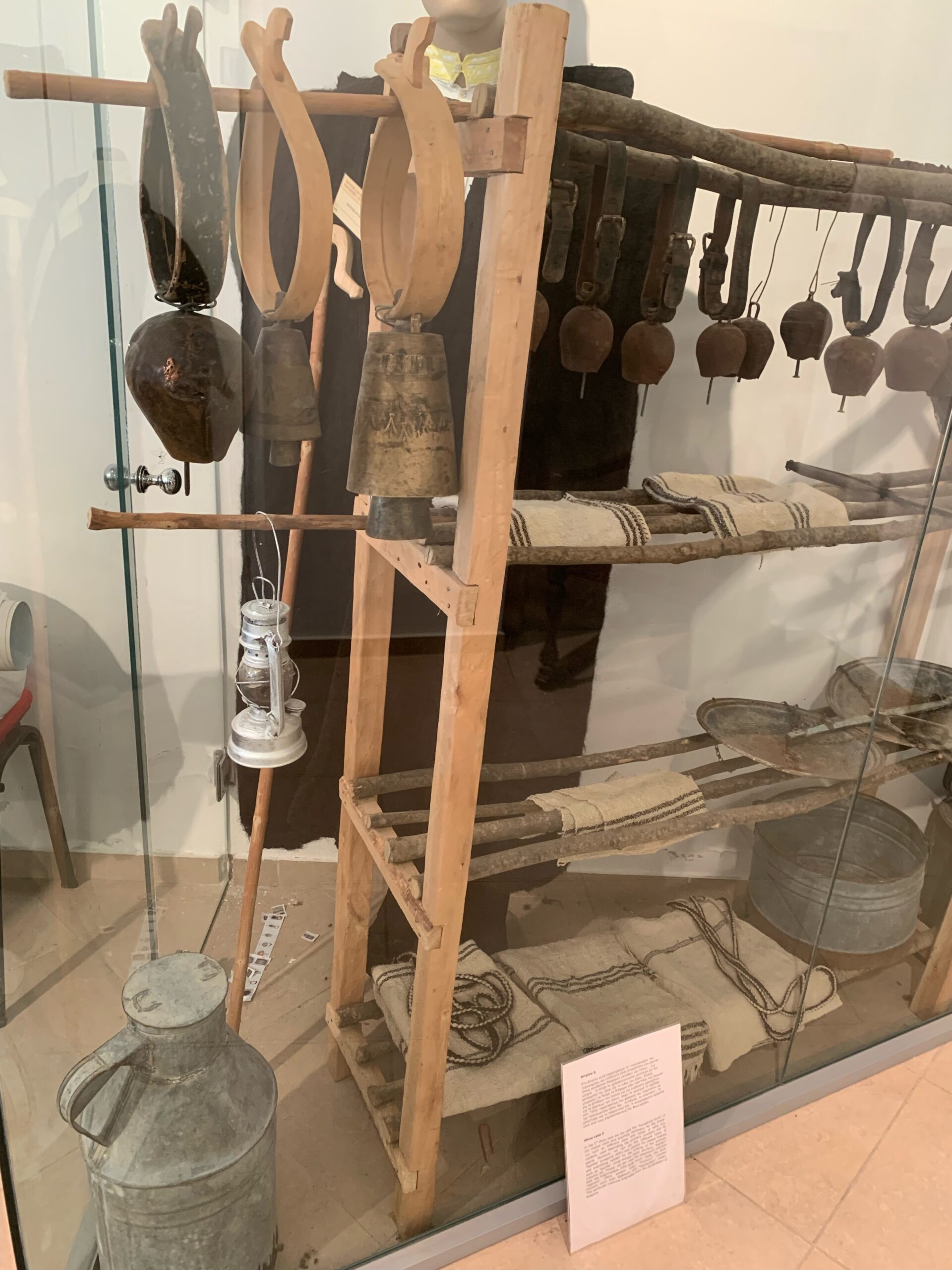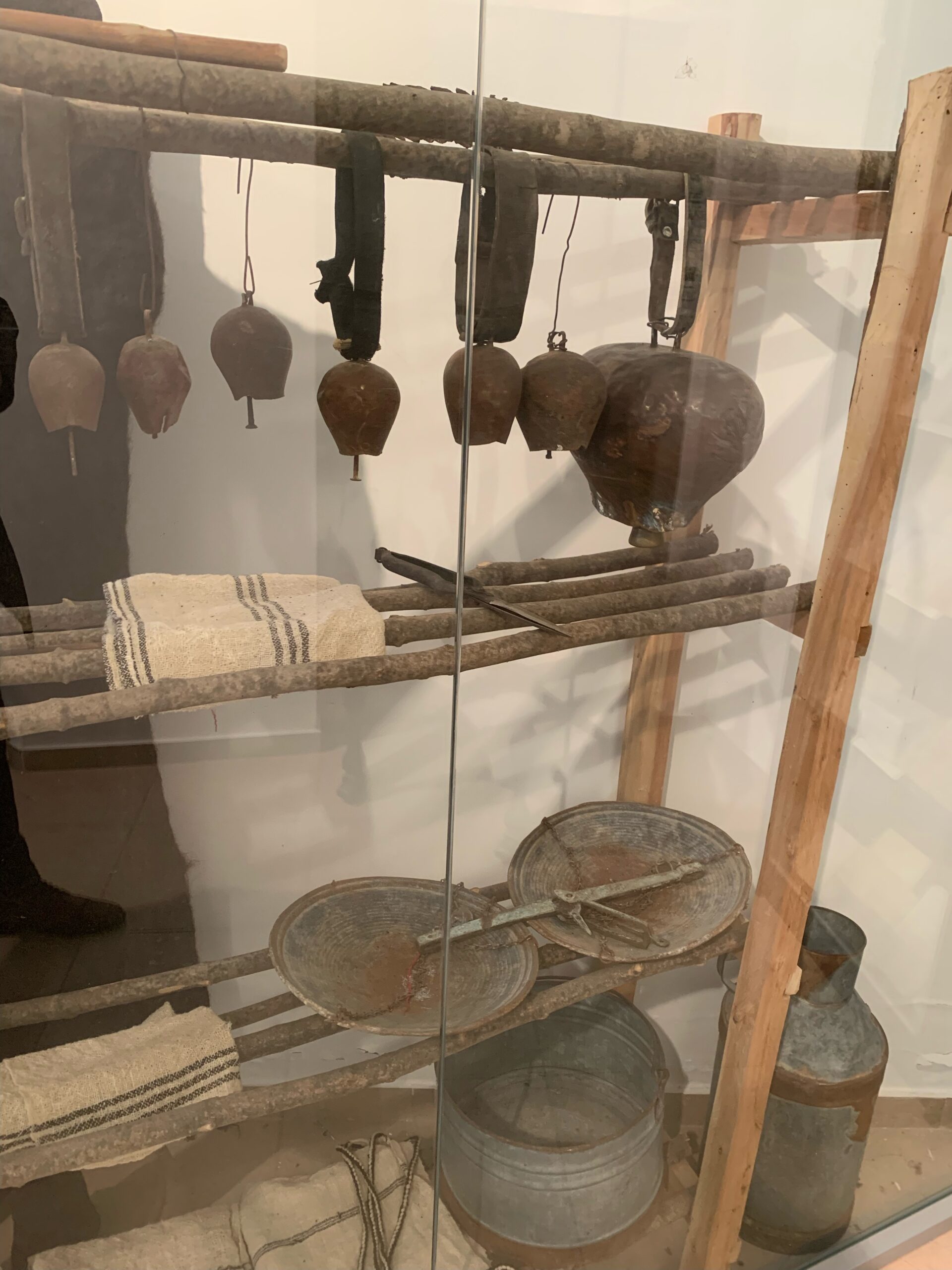
Στη βιτρίνα αυτή παρατηρούμε το «νοικοκυριό» του τυροκομείου και οτιδήποτε είναι απαραίτητο στο μαντρί. Όπως κουδούνια διαφόρων μεγεθών και τύπων , π.χ κυπριά , τα οποία τα χρησιμοποιούσαν ανάλογα με την κατάσταση του ζώου και το είδος του ζώου. Επίσης μπορούμε να δούμε τα διάφορα είδη τσαντίλας και σκευών για το φτιάξιμο του τυριού και για οτιδήποτε χρειαζόταν για το άρμεγμα των ζώων, όπως τα γκιούμια το καρδάρι κλπ. Τέλος παρατηρούμε την φορεσιά του τσομπάνου με την τραγομαλίσια κάπα του , το κάμσο, το σισγκούνι , το μπουτούρι και το τσαμαντανι του. Η συγκεκριμένη φορεσιά είναι από τους Σαρακατσανους της Βουλγαρίας.
In the 5th show case we can view the "household items" of the cheese room and anything necessary for the sheep- run such as different sizes and types of bells e.g. cowbells, used depending the animal's condition and its specie. Moreover, we can see the different types of "tsantila" (wrapping cloth) and utensils for cheese making and everything needed for the milking of the animals, such as "giumia" (long-necked metal pitcher), "kardari" (churns) etc. Finally, we can view the shepherd's costume with the tragomallisia (billy-goat wool) cloak, the shirt, "sigkouni" (thick woolen coat), "boutouri" (woolen trousers worn with Sigkouni) and "tsamantani" (vest). This particular costume originates from the Sarakatsani of Bulgaria.
Vitrine 5 Dans la 5ème vitrine, nous pouvons voir les "articles ménagers" de la fromagerie et tout ce qui est nécessaire à la bergerie, comme différentes tailles et types de cloches, par ex. cloches à vache, utilisées en fonction de la condition de l'animal et de son espèce. En outre, nous pouvons voir les différents types de "tsantila" (tissus d'emballage) et d'ustensiles pour la fabrication du fromage et tout ce qui est nécessaire à la traite des animaux, comme la "giumia" (pichet en métal à long col), les "kardari" (barattes). etc. Enfin, on peut voir le costume de berger avec le manteau de tragomallisia (laine de bouc), la chemise, le « sigkouni » (manteau épais en laine), le « boutouri » (pantalon en laine porté avec Sigkouni) et le « tsamantani » (gilet). . Ce costume particulier provient des Sarakatsani de Bulgarie.