
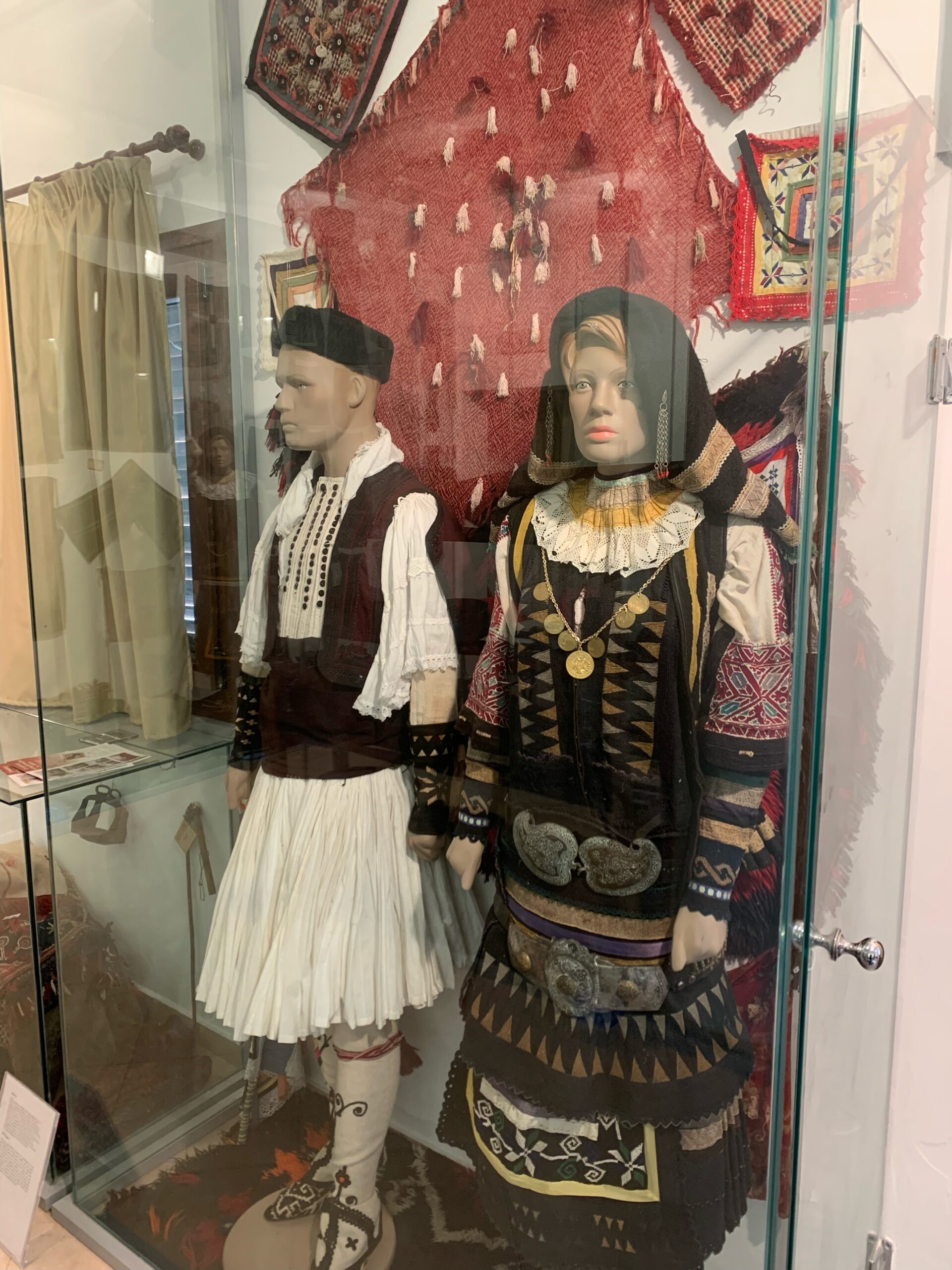
Βιτρίνα 1
Είναι η βιτρίνα όπου είναι τοποθετημένα αντικείμενα τα οποία σχετίζονται και χρησιμοποιούσαν στο γάμο.
Πίσω διακρίνονται οι κουλουροτροβάδες στολισμένοι με φούντες κόκκινες, όπως επίσης στη μέση βλέπουμε έναν πορφυρού χρώματος του Βυζαντίου(1900) φλάμπουρα, και αριστερά και δεξιά τα σακουλάκια για τα καλούδια.
Κάτω από τον φλάμπουρα αυτό βλέπουμε την γαμπροβέλεντζα ή καρπέτα, την οποία στην χρησιμοποιούσαν για στρωσίδι στη σέλα του γαμπρού, όπως και το μαντήλι που έβαζε ο πεθερός (πατέρας της νύφης) στον φλάμπουρα.
In the first show case, placed at the Museum entrance, we can see the costumes of the bride and the groom. Here are placed items related to and used in a wedding. Behind them there are the "koulourotrovades" (bags for carrying the wedding bread) adorned with red bobbles; in the middle we can view a "flampoura" (banner made in weddings to represent the joy of the occasion, par excellence emblem of Sarakatsani) of deep red colour dated from Byzantium (1900), and on the right and left there are the sachets for the "kaloudia" (treats). Beneath this "flampoura" we can see the "gamprovelentza" (bocking of the groom) or "karpeta", which was placed as bedding over the horse saddle, as well as the "mantili" (handkerchief) that the father-in-law (father of the bride) used to put on the flampoura.
At the bottom of the show case there are placed three other kinds of flampoura, one of which is the museum's emblem, as shown in our website.
Dans la première vitrine, placée à l'entrée du Musée, on peut voir les costumes des mariés. Voici des objets placés liés et utilisés lors d’un mariage. Derrière eux se trouvent les « koulourotrovades » (sacs pour transporter le pain de noce) ornés de pompons rouges ; au milieu on peut voir une "flampoura" (bannière fabriquée lors des mariages pour représenter la joie de l'occasion, emblème par excellence de Sarakatsani) de couleur rouge foncé datée de Byzance (1900), et à droite et à gauche se trouvent les sachets pour les "kaloudia" (friandises). Sous cette « flamboura », on peut voir la « gamprovelentza » (bocking du marié) ou « karpeta », qui était placée comme literie sur la selle du cheval, ainsi que le « mantili » (mouchoir) que le beau-père (père de la mariée) mettait la flamboura.
Βιτρίνα 2
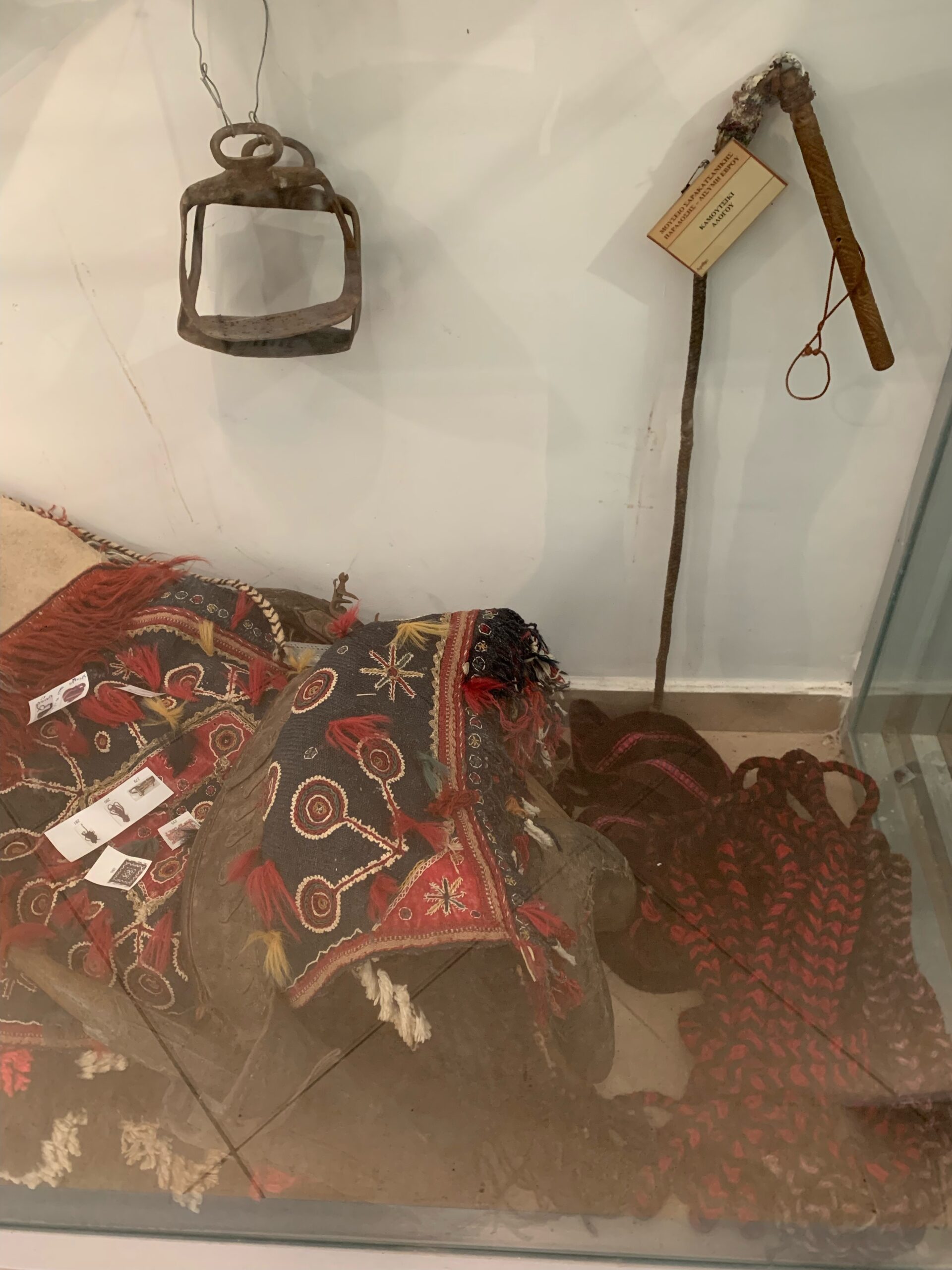
Εδώ ο επισκέπτης μπορεί να δει τα εξαρτήματα για το άλογο. Το σαμάρι, τις τριχιές και άλλα είδη που χρησιμοποιούσε ο αναβάτες του αλόγου, αλλά και την καρπέτα την οποία όπως είδαμε και στην προηγούμενη βιτρίνα την στρώναν στη σέλα του γαμπρού, όπως επίσης βλεπουμε την «καπλιά» , ένα κομμάτι πανί που το στρώναν στα καπούλια από το άλογο, για να τοποθετήσουν πάνω τα αντικείμενα που ήταν για μεταφορά. Στη περίπτωση του γάμου η καπλιά ήταν στολισμένη με κορδέλες και φούντες, για να είναι επίσημη. Τέλος πάνω στο σαμάρι βλεπουμε τις θήκες για τα όπλα.
Πίσω διακρίνονται οι κουλουροτροβάδες στολισμένοι με φούντες κόκκινες, όπως επίσης στη μέση βλέπουμε έναν πορφυρού χρώματος του Βυζαντίου(1900) φλάμπουρα, και αριστερά και δεξιά τα σακουλάκια για τα καλούδια.
Κάτω από τον φλάμπουρα αυτό βλέπουμε την γαμπροβέλεντζα ή καρπέτα, την οποία στην χρησιμοποιούσαν για στρωσίδι στη σέλα του γαμπρού, όπως και το μαντήλι που έβαζε ο πεθερός (πατέρας της νύφης) στον φλάμπουρα.
This show case offers to visitors the opportunity to view some of the horse fittings: pack saddle, rope, and other items that the horse riders used, as well as the "karpeta" which as we have shown in the previous show case used to be placed on the groom's saddle. In addition, we see the "kaplia", a piece of cloth that used to be placed on the horse's croups in order to pjace on it the items that were to be carried. In case of a wedding, kaplia was adorned with ribbons and bobbles so as to be formal. Finally, over the pack saddle we can see the gun-case.
At the bottom of the show case there are placed three other kinds of flampoura, one of which is the museum's emblem, as shown in our website.
Cette vitrine offre aux visiteurs la possibilité de voir une partie de l'équipement du cheval : bât, corde et autres objets utilisés par les cavaliers, ainsi que la "karpeta" qui, comme nous l'avons montré dans la vitrine précédente, était autrefois placé sur la selle du marié. De plus, on voit le "kaplia", un morceau de tissu qu'on plaçait autrefois sur les croupes du cheval afin d'y placer les objets à transporter. En cas de mariage, le kaplia était orné de rubans et de pompons pour être formel. Enfin, au-dessus du bât, on aperçoit l'étui du fusil.
Βιτρίνα 3
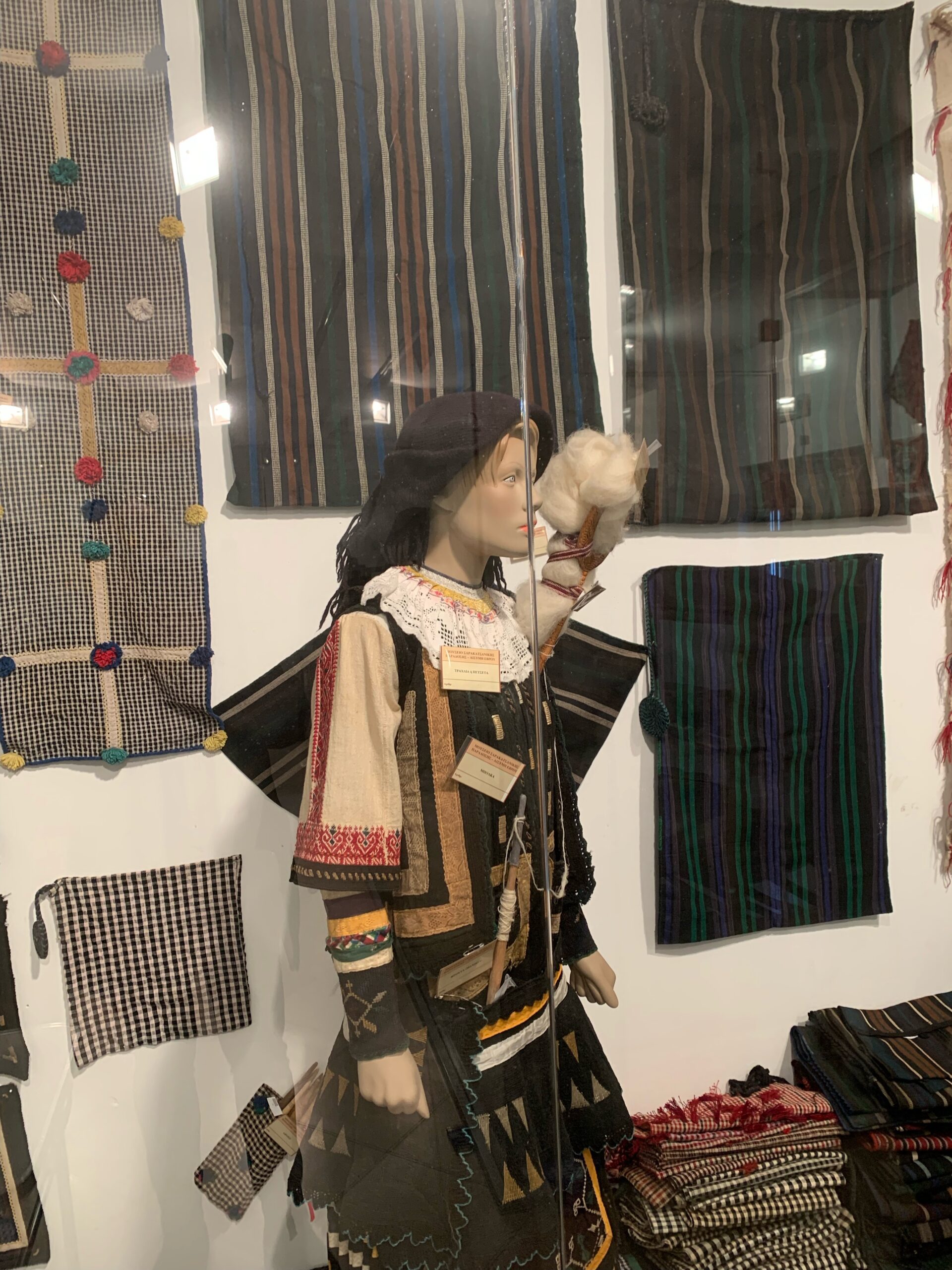
Στη βιτρίνα 3 βρίσκουμε κάποια είδη βελέντζας , όπως βελέντζα με κοντά κλόσσια, ραμματίσια κ.α, επίσης υπάρχουν χαράρια (μεγάλα σακιά ) μαλλοσάκια, αλευροσάκια, τροβάδες δισάκια, τάβλες και άλλα υφαντά.Τα υφαντά αυτά τα έφτιαχναν οι Σαρακατσάνες, στον αργαλειό, αφού πρώτα είχαν επεξεργαστεί το μαλλί με το λανάρι, τη ρόκα και άλλα μέσα που χρησιμοποιούσαν για την δουλειά αυτή και τα οποία τα βλέπουμε στην βιτρίνα αυτή. Επίσης, στη βιτρίνα αυτή διακρίνονται κάποια κομμάτια της γυναικείας φορεσιάς όπως οι κάλτσες, οι πατούνες και η πιο χαρακτηριστική ποδιά της Σαρακατσάνικης φορεσιάς, η «ΠΑΝΑΟΥΛΑ», πάνω στην οποία καταγραφόταν η κατάσταση της Σαρακατσάνας γυναίκας (Αρραβωνιασμένη, Παντρεμένη, Λεχώνα, κ.λ.π)
In the 3rd show case we can view some types of velentza (bocking), such as a velentza with short tassels, rammatisia (fine thread bocking) and others. In addition, there are the hararia (big sacks), mallosakia (sacks for the wool), alevrosakia (sacks for the flour), trovades (bags), disakia (saddle bags), tavles (boards) and other textiles. These textiles were made by Sarakatsanes in the argaleios (weaving loom) after having processed at first the wool with "lanari" (comb), roka (distaff) and other means used for this job that can be viewed here. Moreover, in this show case it can also be seen some pieces of the women's costume such as socks, patounes (pair of woolly short socks) and the most characteristic apron of the Sarakatsani costume, the so-called "PANAOULA", on which was written the status of the Sarakatsana woman (engaged, married, recently given birth etc.).
Dans la 3ème vitrine, nous pouvons voir certains types de velentza (bocking), comme la velentza à pompons courts, la rammatisia (bocking à fil fin) et d'autres. À cela s'ajoutent les hararia (grands sacs), les mallosakia (sacs pour la laine), les alevrosakia (sacs pour la farine), les trovades (sacs), les disakia (sacs de selle), les tavles (planches) et d'autres textiles. Ces textiles étaient fabriqués par les Sarakatsanes dans l'argaleios (métier à tisser) après avoir d'abord traité la laine avec du "lanari" (peigne), du roka (quenouille) et d'autres moyens utilisés pour ce travail que l'on peut voir ici. De plus, dans cette vitrine, on peut également voir quelques pièces du costume féminin telles que des chaussettes, des patounes (paire de chaussettes courtes en laine) et le tablier le plus caractéristique du costume Sarakatsani, le soi-disant "PANAOULA", sur lequel était écrit le statut de la femme Sarakatsana (fiancée, mariée, récemment accouchée, etc.).
Βιτρίνα 4
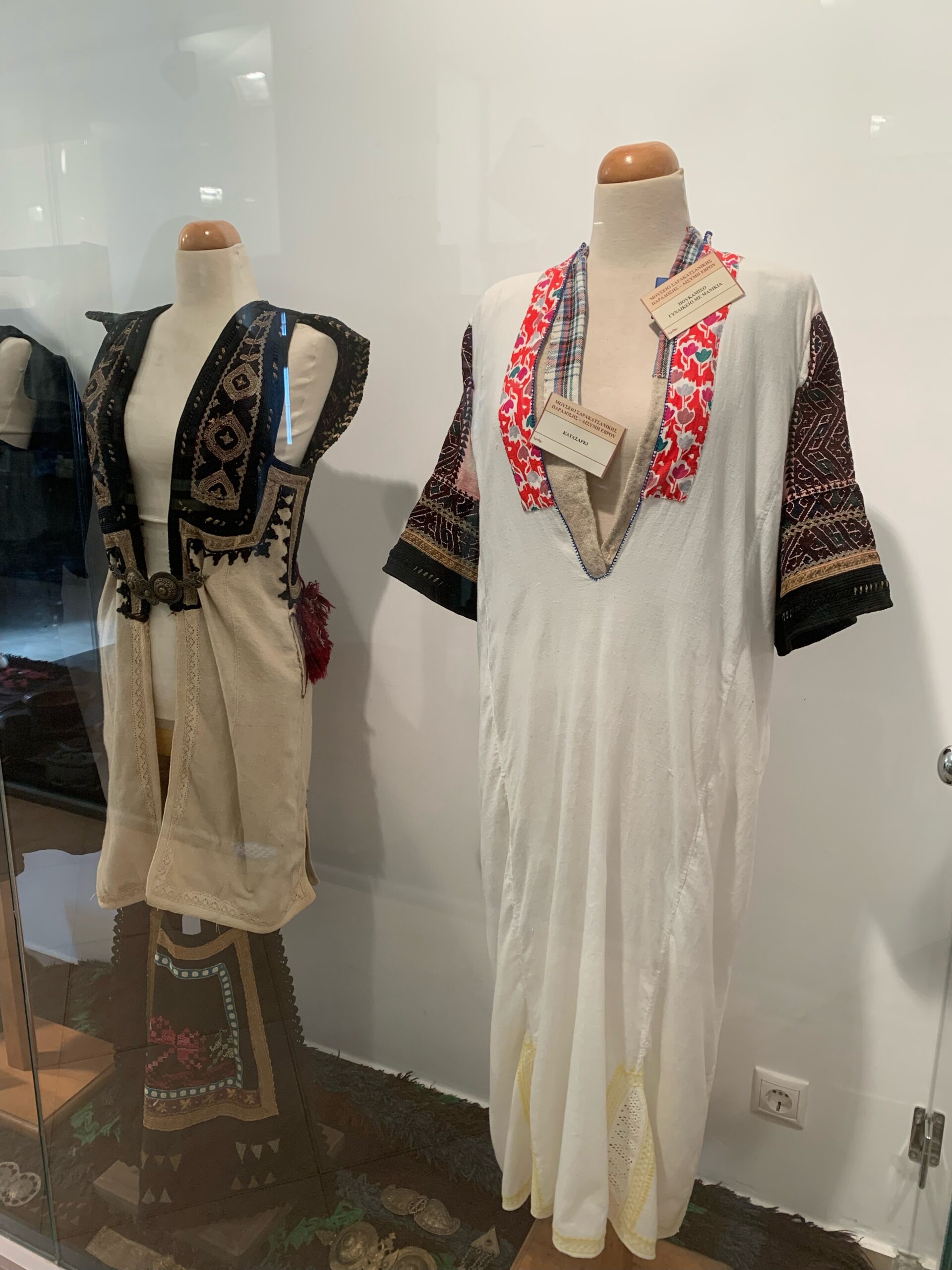
Στη βιτρίνα αυτή βρίσκεται η φορεσιά μια μικρής Σαρακατσάνας, με το τσαμαντάνι, τη φούστα, το ζωνάρι, την μπόλκα, την τραχλιά ή πετσέτα, το πουκάμισο που ξεχωρίζει κάτω από την φούστα, την ποδιά, αλλά και τα χειρότια (τα γυναικεία ζγαρόνια). Στο κεφάλι φοράει τον μπόχο
Επίσης διακρίνονται οι ανδρικές και γυναικείες Σαρακατσάνικες φορεσιές. Η φουστανέλα , το Σιγκούνι, Η Τραγομαλλίσια κάπα, αλλά και η Λεχώνα με την σκούρα στολή της, και το αγόρι με το σιγκούνι. Παρατηρούμε τα όπλα, τις κλίτσες, τα γκουζόκια, το γυναικείο πανωφόρι, ενδύματα που φορούσαν οι Σαρακατσάνοι και οι Σαρακατσάνες στην καθημερινή ζωή αλλά και στις επίσημες στιγμές τους, όπως ήταν ο γάμος .
In this show case is placed the costume of the young Sarakatsana, with the "tsamantani" (kind of vest), the skirt, the belt, the "bolka" (jacket), the "trahlia" or towel, the shirt distinguished beneath the skirt, the apron, as well as the "hirotia" (women's gloves). On the head she wears the boho (woven head-dress). In addition, there are seen the male and female Sarakatsani costumes. The fustanella (a kind of Greek kilt), the sigkouni (daily male costume), the tragomallisia (billy-goat wool) cloak, and the Lehona (woman recently given birth) with her dark costume, and the boy with the sigkouni. We can also see the guns, "klitses" (sheep hooks), "gkouzokia", female coat, clothes worn by Sarakatsani in everyday life and in official moments, such as a wedding.
Dans cette vitrine est placé le costume du jeune Sarakatsana, avec le "tsamantani" (sorte de gilet), la jupe, la ceinture, la "bolka" (veste), la "trahlia" ou serviette, la chemise distinguée sous le la jupe, le tablier, ainsi que les « hirotia » (gants pour femmes). Sur la tête elle porte le boho (coiffe tissée). De plus, on y voit les costumes Sarakatsani masculins et féminins. La fustanella (sorte de kilt grec), le sigkouni (costume quotidien masculin), le manteau tragomallisia (laine de bouc), et la Lehona (femme récemment accouchée) avec son costume sombre, et le garçon avec le sigkouni. On peut également voir les fusils, les « klitses » (crochets à mouton), les « gkouzokia », manteau féminin, vêtements portés par Sarakatsani dans la vie quotidienne et dans les moments officiels, comme un mariage.
Βιτρίνα 5
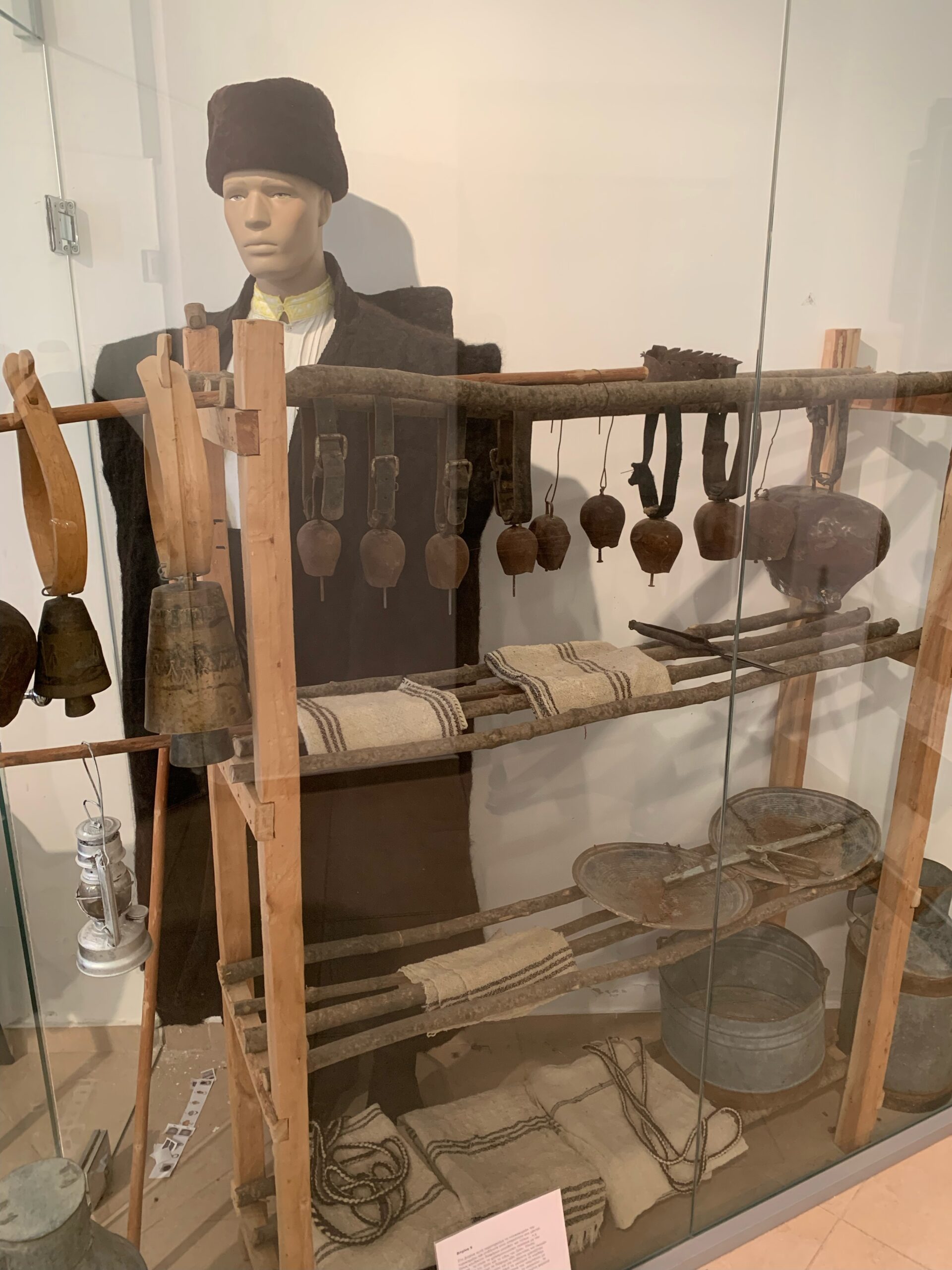
Στη βιτρίνα αυτή παρατηρούμε το «νοικοκυριό» του τυροκομείου και οτιδήποτε είναι απαραίτητο στο μαντρί. Όπως κουδούνια διαφόρων μεγεθών και τύπων , π.χ κυπριά , τα οποία τα χρησιμοποιούσαν ανάλογα με την κατάσταση του ζώου και το είδος του ζώου. Επίσης μπορούμε να δούμε τα διάφορα είδη τσαντίλας και σκευών για το φτιάξιμο του τυριού και για οτιδήποτε χρειαζόταν για το άρμεγμα των ζώων, όπως τα γκιούμια το καρδάρι κλπ. Τέλος παρατηρούμε την φορεσιά του τσομπάνου με την τραγομαλίσια κάπα του , το κάμσο, το σισγκούνι , το μπουτούρι και το τσαμαντανι του. Η συγκεκριμένη φορεσιά είναι από τους Σαρακατσανους της Βουλγαρίας.
In the 5th show case we can view the "household items" of the cheese room and anything necessary for the sheep- run such as different sizes and types of bells e.g. cowbells, used depending the animal's condition and its specie. Moreover, we can see the different types of "tsantila" (wrapping cloth) and utensils for cheese making and everything needed for the milking of the animals, such as "giumia" (long-necked metal pitcher), "kardari" (churns) etc. Finally, we can view the shepherd's costume with the tragomallisia (billy-goat wool) cloak, the shirt, "sigkouni" (thick woolen coat), "boutouri" (woolen trousers worn with Sigkouni) and "tsamantani" (vest). This particular costume originates from the Sarakatsani of Bulgaria.
Vitrine 5 Dans la 5ème vitrine, nous pouvons voir les "articles ménagers" de la fromagerie et tout ce qui est nécessaire à la bergerie, comme différentes tailles et types de cloches, par ex. cloches à vache, utilisées en fonction de la condition de l'animal et de son espèce. En outre, nous pouvons voir les différents types de "tsantila" (tissus d'emballage) et d'ustensiles pour la fabrication du fromage et tout ce qui est nécessaire à la traite des animaux, comme la "giumia" (pichet en métal à long col), les "kardari" (barattes). etc. Enfin, on peut voir le costume de berger avec le manteau de tragomallisia (laine de bouc), la chemise, le « sigkouni » (manteau épais en laine), le « boutouri » (pantalon en laine porté avec Sigkouni) et le « tsamantani » (gilet). . Ce costume particulier provient des Sarakatsani de Bulgarie.
Βιτρίνα 6
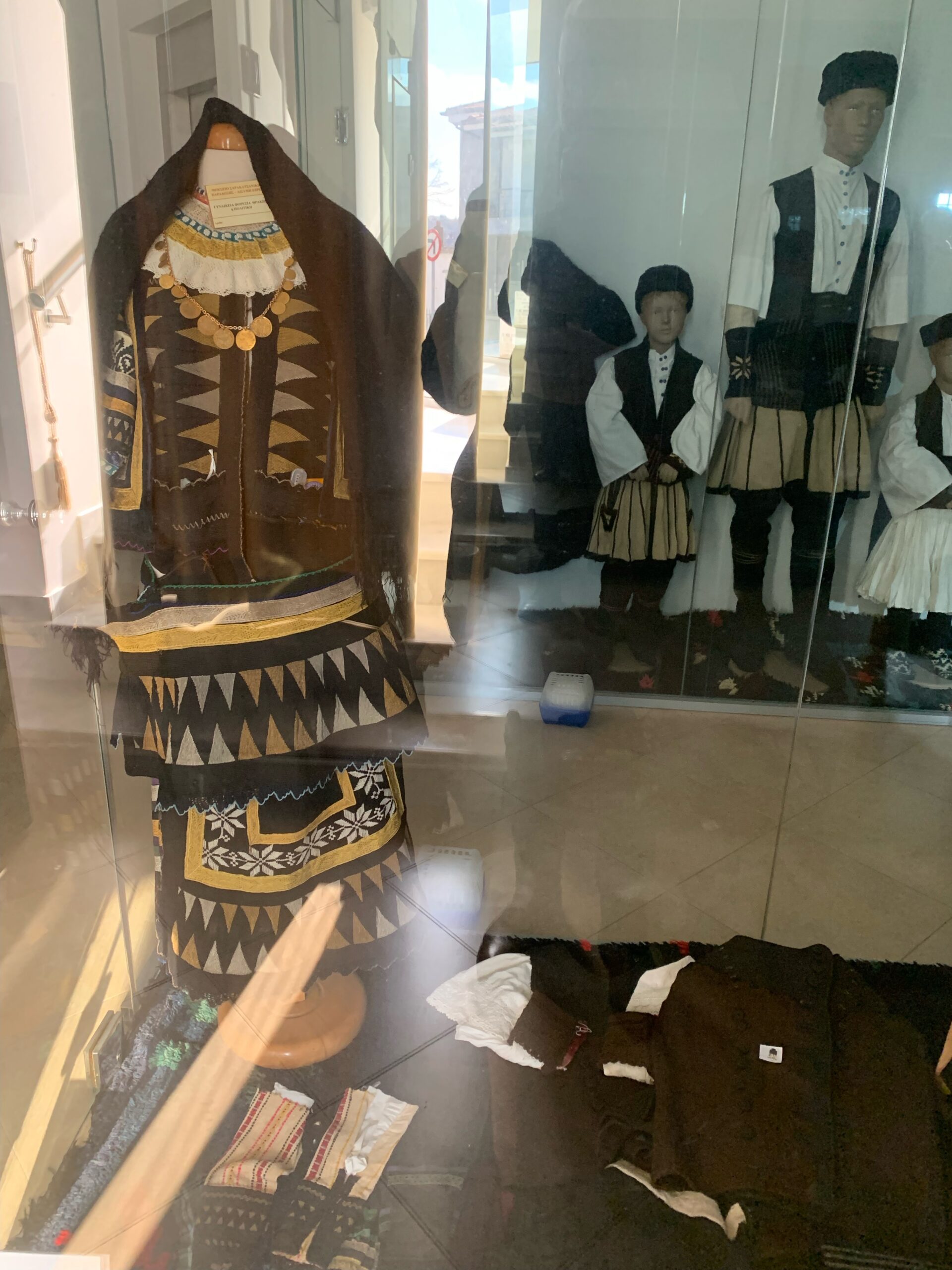
Εδώ είναι τοποθετημένα κάποια κομμάτια της γυναικείας φορεσιάς, όπως φούστες, ζωνάρια, τσαμαντάνια, αλλά και ένα νεότερο είδος γυναικείας φορεσιάς, η μακρόφουστα την οποία βλέπουμε φορεμένη στην κούκλα, με την ζυμοποδιά.
Επίσης στην βιτρίνα αυτή έχουν τοποθετηθεί και τα οικιακά σκεύη ενός Σαρακατσάνικου νοικοκυριού όπως, τα Κακάβια, ο σοφράς, ο γάστρος, η τάβλα, τα ταψιά, τα τσκαλάκια, η κόφα, το κλειδοπίνακο κ.α.
Εκθέτονται και άλλα είδη του νοικοκυριού , όπως η πινακωτή τα κακαβούλια, χειρόμυλοι του καφέ και σκαφίδι, που δεν φαίνονται στην φωτογραφία αυτή και τα οποία μπορείτε να τα δείτε με μία επίσκεψη στο Μουσείο.
In this show case are placed some pieces of the female costume such as skirts, belts, "tsamantania" (vest), as well as the latest item of the female costume, the "makrofousta" (long skirt) that is placed on the dress stand with the "zimopodia" (apron for blending).
Moreover, in this show case are placed some utensils of a Sarakatsani home such as "kakavia" (saucepan), "sofras" (round low table), "gastros" (roasting pan with lid), "tavla" (board), "tapsia" (roasting pans), "tskalakia" (cooking pots), "kofa" (basket), "kleidopinako" (tuck box with a safe lid) etc.
In addition, the visitor can view some other items of a household such as "pinakoti" (kneading trough), "kakavoulia" (small saucepan), coffee querns and "skafidi" (wooden kneading through), which are not shown in this picture but you can view them when visiting the Museum.
Vitrine 6 Dans cette vitrine sont placées quelques pièces du costume féminin telles que les jupes, les ceintures, la "tsamantania" (gilet), ainsi que le dernier élément du costume féminin, la "makrofousta" (jupe longue) qui est placée sur la robe. stand avec le "zimopodia" (tablier pour mélanger). De plus, dans cette vitrine sont placés quelques ustensiles d'une maison Sarakatsani tels que "kakavia" (casserole), "sofras" (table basse ronde), "gastros" (rôtissoire avec couvercle), "tavla" (planche), " tapsia" (rôtissoires), "tskalakia" (marmites), "kofa" (panier), "kleidopinako" (boîte avec couvercle sécurisé), etc. De plus, le visiteur peut voir quelques autres objets de la maison tels que le "pinakoti" (pétrin), le "kakavoulia" (petite casserole), les cafetières et le "skafidi" (pétrin en bois), qui ne sont pas représentés sur cette photo. mais vous pouvez les voir lors de la visite du Musée.
Βιτρίνα 7
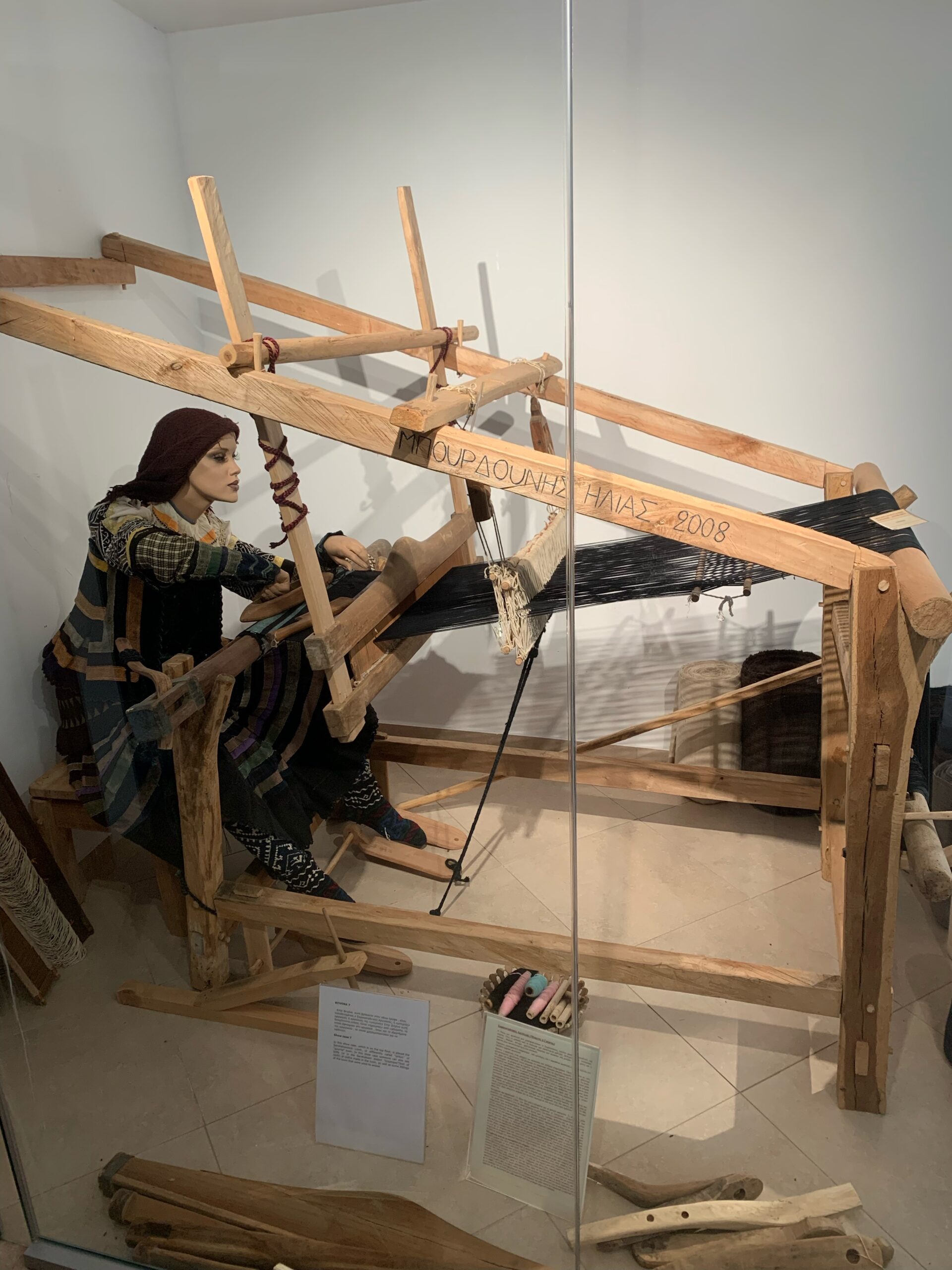
Στην Βιτρίνα αυτή βρίσκεται στον πάνω όροφο , είναι τοποθετημένος ο Σαρακατσάνικος Αργαλειός, ή «μπηχτός» αργαλειός ή αργαλειός της «γούρνας». Στην βιτρίνα αυτή διακρίνονται επίσης τόπια «τρούμπες» από υφάσματα, τα οποία έφτιαχναν στο αργαλειό , όπως και τα εξαρτήματα του αργαλειού , τα οποία χρησιμοποιούσαν για να υφάνουν.
In this show case, which is on the top floor, is placed the Sarakatsanikos Loom, or differently called "bihtos" or "gourna" loom. In this show case someone can also see bolts (or in the Sarakatsani dialect "troumpes"(bolt of cloth) of cloths made in the loom, as well as some fittings of the loom that were used to weave.
Dans cette vitrine, située au dernier étage, est placé le métier à tisser Sarakatsanikos, ou autrement appelé "bihtos" ou "gourna". Dans cette vitrine, on peut également voir des boulons (ou dans le dialecte Sarakatsani « troumpes » (boulon de tissu) de tissus fabriqués sur le métier à tisser, ainsi que certains accessoires du métier à tisser qui étaient utilisés pour le tissage.
Βιτρίνα 8
Δίπλα στην βιτρίνα βρίσκεται η ‘’ΤΣΙΑΤΟΥΡΑ’’.
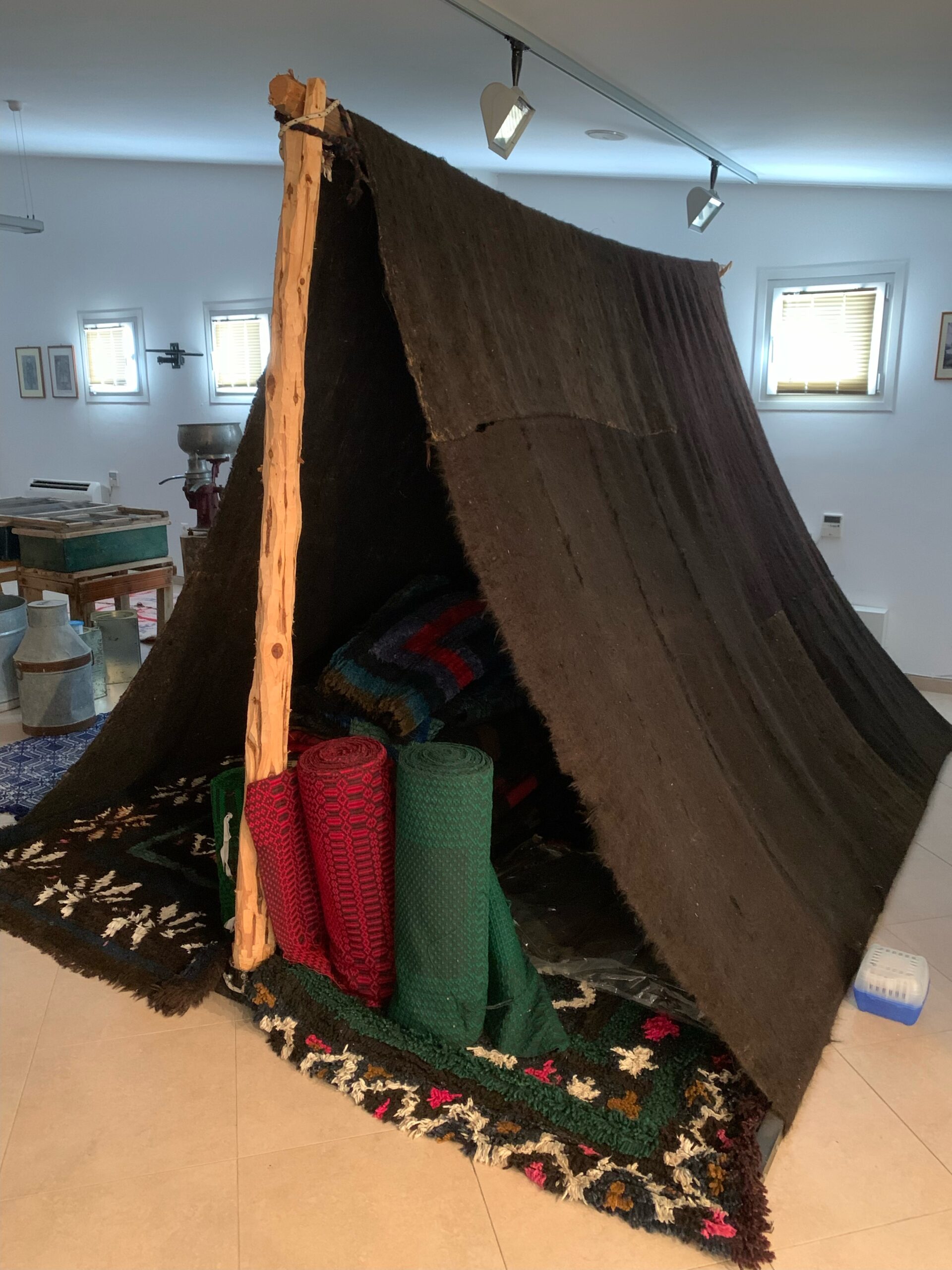
Είναι πρόχειρο κατάλυμα καλυμμένο με υφαντό χονδρό, από κατσικίσιο μαλλί, (όμοιο με την κατασκευή της ‘’ΚΑΠΑΣ’’, όπου διέμεναν με όλα τα υπάρχοντά τους κατά το διάβα (διαδρομή) από τα χειμαδιά στα Ξεκαλοκαιριά και το αντίστροφο το καλοκαίρι. Κατά την διαδρομή τα ζωντανά τους και οι ίδιοι ήταν πεζοί τα δε υπάρχοντά τους (τροφές-ρουχισμός κλπ) φορτωμένα στα άλογα. Η διαδρομή ήταν αρκετά μεγάλη και έτσι έπρεπε να γίνουν ενδιάμεσες στάσεις και διανυκτερεύσεις. Εκεί έστηναν την Τσιατούρα και το επόμενο πρωινό τα μάζευαν για την επόμενη στάση.
Next to the show case is "CIATOURA".
It is a temporary lodging covered with coarse woven goat wool (similar to the construction of the "KAPAS", where they lived with all their belongings during the journey from the winters to Xekalokairia and vice versa in the summer. During the route their livestock and they themselves were on foot and their belongings (food-clothing etc) loaded on the horses. The route was quite long and so intermediate stops and overnight stays had to be made. There they set up Chiatura and the next morning they collected them for the next stop.
A côté de la vitrine se trouve "CIATOURA". Il s'agit d'un logement temporaire recouvert de laine de chèvre grossièrement tissée (semblable à la construction du "KAPAS", où ils vivaient avec tous leurs biens pendant le voyage depuis les hivers jusqu'à Xekalokairia et vice versa en été. Pendant le trajet, leur bétail et eux-mêmes étaient à pied et leurs affaires (nourriture, vêtements, etc.) étaient chargées sur les chevaux. Le parcours était assez long et il fallait donc faire des arrêts intermédiaires et des nuitées. Là, ils installèrent Chiatura et le lendemain matin ils les récupérèrent pour le voyage. prochain arrêt.
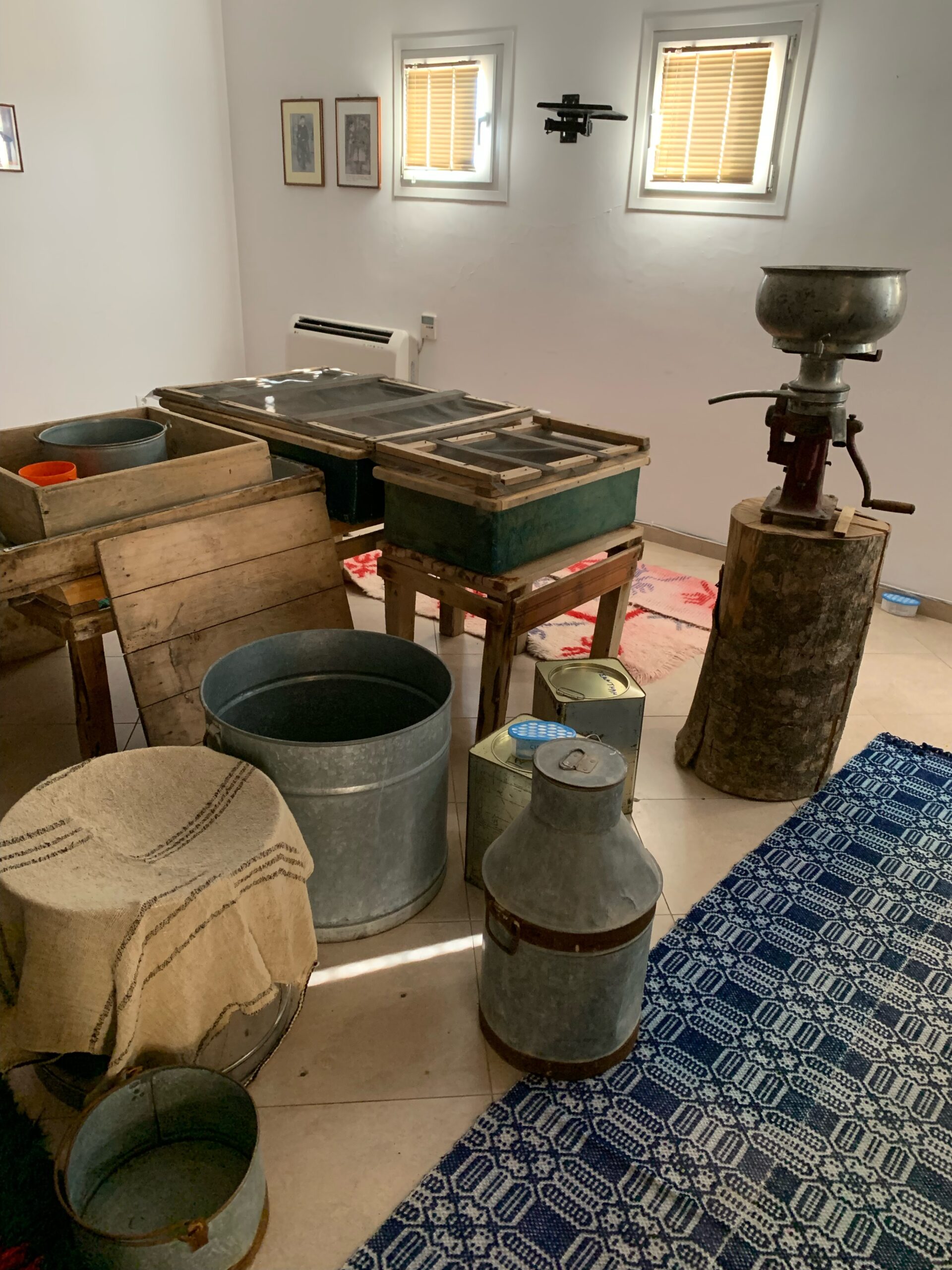
Βιτρίνα 9
Δίπλα στην βιτρίνα βρίσκεται η ‘’ΤΣΙΑΤΟΥΡΑ’’.
Δίπλα από την Τσιατούρα βρίσκονται όλα τα σκεύη για την παρασκευή του τυριού.
α) Τα γκιούμια με τα οποία μετέφεραν το γάλα από τον χώρο αρμέγματος των αιγοπροβάτων (δηλ. την στρούγκα).
β) Το καζάνι όπου έριχναν το γάλα για να το πήξουν σε τυρί. Στο καζάνι έδεναν δύο τρείς τσαντήλες χειροποίητες (πανί) για να στραγγίζουν το γάλα δηλαδή να παρακρατούν τυχόν σκουπίδια ακόμα και την σκόνη.
γ) Το τηζιάκι όπου σε μια μεγάλη τσαντήλα μάζευαν το τυρί από το καζάνι για να στραγγίσει (δηλαδή να φύγει το τυρόγαλο).
δ) Δίπλα η κουπάνα όπου υπήρχε ισχυρή άλμα και έβαζαν το στραγγισμένο από το τηζιάκι τυρί για να σφύξει.
ε) Επειτα το τυρί μεταφέρονταν στα σκεύη που θα αποθηκεύονταν (δηλαδή σε δοχεία ή βαρέλια και παλαιότερα σε δέρματα αιγοπροβάτων).
Next to the Chiatoura are all the utensils for the preparation of the cheese. a) The giumias with which they transported the milk from the milking area of the goats and sheep (that is, the struga).
b) The cauldron where they poured the milk to curdle it into cheese. Two or three handmade tsantiles (cloth) were tied to the cauldron to drain the milk, that is, to retain any garbage and even dust.
c) The tiziaki where the cheese was collected from the cauldron in a large bowl to drain (that is, to remove the curd).
d) Next to the koupana where there was a strong brine and they put the cheese drained from the kettle to rise.
e) The cheese was then transferred to the containers to be stored (that is, in containers or barrels and earlier in sheep and goat skins).
Ustensiles pour faire du fromage A côté de la Chiatoura se trouvent tous les ustensiles pour la préparation du fromage. a) Les giumias avec lesquels ils transportaient le lait de la zone de traite des chèvres et des brebis (c'est-à-dire le struga). b) Le chaudron où l'on versait le lait pour le cailler en fromage. Deux ou trois tsantiles (tissus) faits à la main étaient attachés au chaudron pour évacuer le lait, c'est-à-dire pour retenir les déchets et même la poussière. c) Le tiziaki où le fromage était récupéré du chaudron dans un grand bol pour l'égoutter (c'est-à-dire pour retirer le caillé). d) À côté de la koupana où il y avait une saumure forte et ils ont mis le fromage égoutté de la bouilloire à lever. e) Le fromage était ensuite transféré dans les conteneurs pour être stocké (c'est-à-dire dans des conteneurs ou des fûts et auparavant dans des peaux de mouton et de chèvre).